
Intestacy and blended families in North Carolina: what happens without a plan
If you die without a valid will or trust in North Carolina, the state decides who gets your assets. Not your spouse. Not your children. The state. And for blended families, unmarried partners, and high-income professionals with complex family structures, the results can be devastating.
This page explains how North Carolina’s intestacy laws work under NCGS Chapter 29, maps out the specific scenarios where blended families face the most significant risks, and shows you why a plan that accounts for stepchildren, prior marriages, and non-traditional family structures is not optional at your income level.
On this page:
• What is intestacy and how does it work in North Carolina?
• How does NCGS Chapter 29 divide assets when there is no will?
• Why are blended families at the highest risk under intestacy?
• How intestacy affects unmarried partners in North Carolina
• Planning strategies for blended families and non-traditional households
• Frequently asked questions
At a glance:
• North Carolina intestacy law (NCGS Chapter 29) distributes assets according to a rigid statutory hierarchy that does not recognize stepchildren, unmarried partners, or close friends as heirs.
• If you are married with one child, your surviving spouse receives the first $60,000 plus half the remaining estate. The child receives the other half. If you have two or more children, the spouse receives the first $60,000 plus one-third of the remaining estate.
• Stepchildren inherit nothing under intestacy unless they were legally adopted. An unmarried partner inherits nothing regardless of how long the relationship lasted.
• For high-income blended families in Raleigh, the gap between what intestacy law provides and what the family actually needs can be hundreds of thousands of dollars or more.
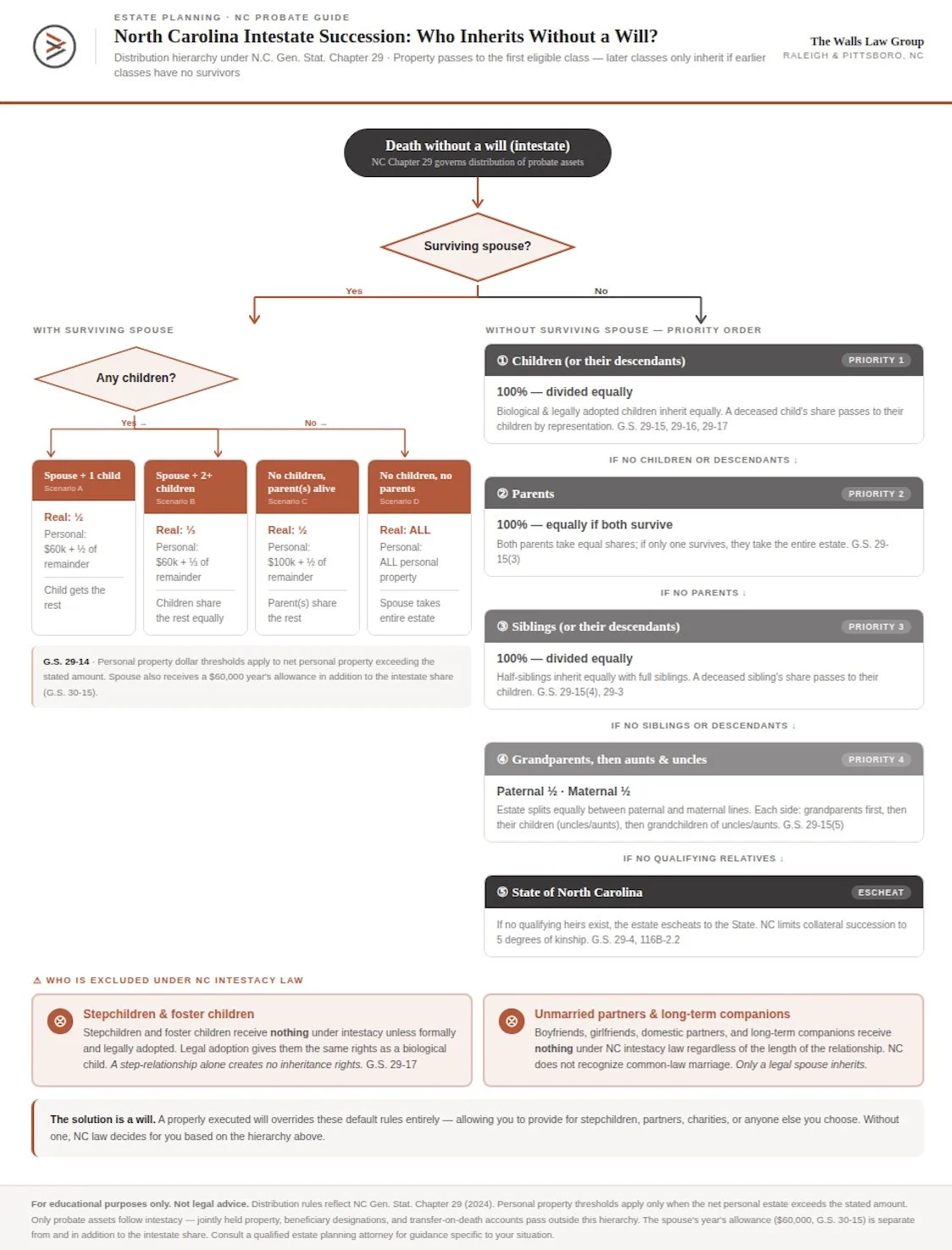
North Carolina intestacy distribution flowchart showing statutory hierarchy under NCGS Chapter 29 with gaps for stepchildren and unmarried partners.
What is intestacy and how does it work in North Carolina?
Intestacy is the legal condition of dying without a valid will. When someone dies intestate in North Carolina, their probate assets are distributed according to the statutory hierarchy established in NCGS Chapter 29. The distribution is based entirely on legal relationships (marriage, biological parentage, legal adoption) and does not account for the deceased person’s wishes, promises, or informal family arrangements.
• The Clerk of Superior Court appoints an administrator (rather than an executor) to manage the estate under NCGS Chapter 28A.
• The administrator has no authority to deviate from the statutory distribution hierarchy. Even if everyone in the family agrees on a different arrangement, the administrator must follow the law.
• Only assets that would pass through probate are subject to intestacy rules. Assets with beneficiary designations (retirement accounts, life insurance), jointly held property with right of survivorship, and trust assets transfer outside of intestacy.
According to NCGS Chapter 29 (Intestate Succession), which defines the statutory distribution for decedents who die without a valid will in North Carolina.
The statutory hierarchy is specific, and for many families, it produces results that nobody would have chosen.
Here’s what I want you to understand about intestacy: it is the state’s default estate plan for you. And it was not designed with your family in mind. It was designed to handle the most common scenarios with a simple formula. If your family fits neatly into that formula, the outcomes may be acceptable. But if you have a blended family, stepchildren, an unmarried partner, or any arrangement that doesn’t match the traditional married-with-biological-children model, the outcomes can be genuinely harmful.
And quite candidly, the families who are most at risk are also the families who are most likely to delay planning. They know the situation is complicated. They know the conversations are difficult. So they put it off. And then the statute makes the decisions for them.
For a detailed breakdown of the statutory distribution formulas, see our intestate succession under NCGS Chapter 29 glossary page.
How does NCGS Chapter 29 divide assets when there is no will?
North Carolina’s intestacy statute distributes assets based on which surviving relatives exist at the time of death. The share each person receives depends on the specific combination of surviving family members.
Surviving spouse with one child or descendant of one child
Under NCGS §29-14, the surviving spouse receives the first $60,000 of the net estate plus one-half of the balance. The child (or the child’s descendants if the child predeceased) receives the remaining one-half.
Surviving spouse with two or more children or their descendants
Under NCGS §29-15, the surviving spouse receives the first $60,000 of the net estate plus one-third of the balance. The children (or their descendants) share the remaining two-thirds equally.
Surviving spouse with no children but surviving parents
The surviving spouse receives the first $100,000 plus one-half of the balance. The parent(s) receive the remaining one-half.
Surviving spouse with no children and no surviving parents
The surviving spouse inherits the entire estate.
No surviving spouse
Under NCGS §29-15, the estate passes entirely to the children in equal shares. If there are no children, it passes to the parents, then to siblings, then to more remote relatives according to the statutory hierarchy.
According to NCGS §29-14 and §29-15, which establish the intestate shares for surviving spouses and descendants in North Carolina.
These formulas assume a traditional family structure. Here’s where blended families run into serious problems.
Let me put real numbers on this so you can see how it works. Say you’re a Raleigh business owner with a $3 million probate estate. You’re married with two children. Under intestacy, your spouse gets the first $60,000 plus one-third of the remaining $2,940,000. That’s $60,000 plus $980,000, for a total of $1,040,000. Your two children split the remaining $1,960,000, or $980,000 each.
Now ask yourself: is that the distribution you would have chosen? For some families, it might be close. For others, it’s nowhere near right. Maybe your spouse needs more to maintain the household. Maybe one child has special needs and requires a trust. Maybe one of those “children” is actually a stepchild who receives nothing under this formula.
The statute doesn’t care about context. It runs the formula and distributes the assets.
Why are blended families at the highest risk under intestacy?
Blended families face the most severe consequences under intestacy because NCGS Chapter 29 does not recognize stepchildren as heirs. A stepchild has no legal right to inherit from a stepparent under North Carolina intestacy law unless the stepparent legally adopted the child. This means a person who raised a stepchild for 20 years, paid for their education, and considered them their own will leave that child nothing under intestacy.
• Stepchildren receive nothing. Under NCGS Chapter 29, only biological and legally adopted children are recognized as descendants. A stepchild who was never adopted has no inheritance rights from the stepparent’s estate, regardless of the relationship.
• Children from a prior marriage may conflict with current spouse. When the deceased has children from a first marriage and a current spouse from a second marriage, intestacy divides the estate between them according to the formula. The surviving spouse receives $60,000 plus one-third (if two or more children). The children from the prior marriage share the remaining two-thirds. This can create immediate financial conflict between the surviving spouse who needs the assets to live and the children who are legally entitled to their share.
• No provision for equalization. If you intended to leave equal shares to biological children and stepchildren, intestacy makes that impossible. Biological children inherit their statutory share. Stepchildren inherit nothing. There is no mechanism for the administrator to equalize distributions.
• Minor children from multiple relationships. When the deceased has minor children from different relationships, intestacy distributes to all biological children equally but provides no structure for managing those funds. Each minor child’s share may require a separate court-supervised guardianship, which is expensive, time-consuming, and offers less flexibility than a trust.
According to NCGS Chapter 29, which limits intestate inheritance to legally recognized family relationships (marriage, biological parentage, and legal adoption).
These aren’t edge cases. They’re the reality for a significant percentage of families in the Triangle.
I want to share something with you that I see in my practice regularly. A couple comes in for a consultation. He has two children from a first marriage. She has one child from a first marriage. They have one child together. Four children total, and they love all four equally. They’ve been a family for 12 years.
Under intestacy, if he dies without a will, here’s what happens: his two biological children and the one child they share inherit his estate. Her child from her first marriage, the stepchild he helped raise for over a decade, inherits nothing. Zero.
And quite candidly, that’s the outcome that devastates families. It’s not a financial problem. It’s an emotional and relational crisis. The stepchild who was part of the family their entire life is told by the legal system that they don’t count. That outcome is 100% preventable with a will or trust that names all four children as beneficiaries.
I want to strongly encourage you to look at your family structure honestly and ask: if the statute made the decisions, would every person I care about be protected? If the answer is no, you need a plan.
How intestacy affects unmarried partners in North Carolina
North Carolina intestacy law does not recognize unmarried partners as heirs, regardless of the length or nature of the relationship. An unmarried partner has no statutory right to inherit any portion of the deceased partner’s estate under NCGS Chapter 29. North Carolina does not recognize common-law marriage, even for couples who have lived together for decades.
• An unmarried partner who shared a home, shared finances, and raised children with the deceased for 30 years inherits nothing under intestacy. The estate passes to children, then parents, then siblings, and so on.
• Joint ownership of real property can provide some protection if the property is held as joint tenants with right of survivorship. However, tenancy in common (the default in North Carolina when two unmarried people purchase property together) does not include a right of survivorship and the deceased’s share goes through probate.
• Beneficiary designations on retirement accounts and life insurance can direct those specific assets to an unmarried partner, but assets without designations follow intestacy rules.
According to NCGS Chapter 29, which limits inheritance rights to legally defined relationships. North Carolina does not recognize common-law marriage under current state law.
For unmarried couples with significant assets, the planning is not just important. It’s the only way to protect each other.
Let me be very clear with you about this: if you are in a committed relationship and you are not married, the law provides your partner with absolutely no inheritance rights. None. It does not matter how long you’ve been together. It does not matter if you own a home together. It does not matter if you have children together (the children have rights, but the partner does not).
This is one of the most urgent planning situations I encounter. A couple in their 50s, both professionals, combined assets of $4 million to $6 million, living together for 15 years. If one of them dies without a plan, the surviving partner could lose the home they share, receive nothing from the estate, and be left financially vulnerable while the deceased’s parents or siblings inherit everything.
A will or trust solves this completely. You name your partner. You specify what they receive. You can provide for them for the rest of their life while also protecting assets for your children. But without that document, your partner has no legal standing.
Planning strategies for blended families and non-traditional households
Estate planning for blended families and non-traditional households requires tools that go beyond a simple will. The goal is to ensure that every person you intend to benefit actually receives what you want them to receive, in the way you want them to receive it, regardless of how NCGS Chapter 29 would distribute your estate.
• Revocable living trust with specific distribution provisions. A trust allows you to name all intended beneficiaries, including stepchildren and unmarried partners, and specify exactly what each person receives. You can create separate shares, stagger distributions over time, and include conditions. Unlike a will, a trust avoids probate and keeps the distributions private.
• Will with explicit bequests to stepchildren. If a trust is not the right fit, a will that specifically names stepchildren and unmarried partners as beneficiaries overrides the intestacy hierarchy. The will must be clear, specific, and properly executed under North Carolina law.
• Beneficiary designation audit. Review every beneficiary designation on retirement accounts, life insurance, and TOD/POD accounts to ensure they align with your wishes. For unmarried partners, these designations may be the primary mechanism for transferring wealth, since intestacy provides nothing.
• Life insurance to equalize. When you want to leave the family home to your current spouse but also provide for children from a prior marriage, life insurance can fund the children’s inheritance without forcing the sale of the home. The policy death benefit goes directly to the named beneficiaries outside of probate.
• QTIP trust for second marriages. A qualified terminable interest property (QTIP) trust provides income to the surviving spouse for their lifetime, then distributes the remaining assets to the children from the first marriage after the surviving spouse’s death. This is one of the most effective tools for balancing competing interests in a blended family.
• Prenuptial or postnuptial agreements. For second marriages involving significant premarital assets, a prenuptial or postnuptial agreement can define which assets remain separate property and which are marital. This clarity reduces conflict and makes the estate plan more predictable.
Trust strategies governed by NCGS Chapter 36C (North Carolina Uniform Trust Code). Will execution requirements under NCGS §31-3.3.
Each of these tools serves a different purpose, and most blended family plans use several of them together.
Here’s how I approach planning for blended families. The first thing we do is map every person you want to protect: your spouse, your biological children, your stepchildren, any grandchildren, and anyone else who depends on you or whom you want to benefit. Then we map the assets: what you own individually, what you own jointly, what has a beneficiary designation, and what would go through probate.
Once we have both maps, we match tools to goals. The revocable living trust handles the bulk of the estate and ensures every person you named receives their share. Life insurance fills gaps where the math doesn’t work otherwise. Beneficiary designations direct retirement accounts and insurance to the right people. And if there’s a second marriage with competing interests, the QTIP trust or a similar structure creates a framework that protects everyone.
And quite candidly, the most important part of this process is the conversation. Not the legal documents. The conversation where you and your spouse sit down and agree on who gets what and why. That conversation prevents the conflict that tears families apart after a death. The documents just formalize what you’ve already decided.
For how probate works and how to avoid it, see how probate works in Wake County. For trust options tailored to high earners, see trust planning for high income earners in NC.
Frequently asked questions
Can a stepchild contest a will that leaves them nothing?
A stepchild who was never legally adopted generally has no standing to contest a will in North Carolina on the basis of being excluded. Will contests are typically limited to claims of undue influence, lack of capacity, or improper execution. However, if the stepchild was promised an inheritance in writing or through a contract, they may have a separate breach-of-contract claim. The simplest way to prevent any dispute is to include all intended beneficiaries in the estate plan and address the reasoning for the distribution explicitly.
Does legal adoption change inheritance rights under intestacy?
Yes. If a stepparent legally adopts a stepchild, that child is treated identically to a biological child under NCGS Chapter 29 for inheritance purposes. The adopted child inherits from both the adoptive parent and the biological parent unless a court order specifies otherwise. Legal adoption is the only way to give a stepchild full intestacy rights.
What if my will says one thing and my beneficiary designation says another?
The beneficiary designation controls. Retirement accounts, life insurance, and TOD/POD accounts pass to the named beneficiary regardless of what the will says. This is one of the most common sources of conflict in blended families: the will names the current spouse, but the 401(k) beneficiary form still names the ex-spouse from a prior marriage. The ex-spouse receives the 401(k). Always review designations alongside your will and trust.
Can I disinherit a biological child in North Carolina?
Yes, with a properly drafted will or trust. North Carolina does not have a "forced heirship" law that guarantees children a share of the estate. However, the disinheritance should be explicit and documented to prevent a will contest. Simply omitting a child from the will can create ambiguity and invite a legal challenge. A clear statement of intent, ideally with the guidance of an estate planning attorney, is the safest approach.
Do I need separate plans for assets in different states?
If you own real property in a state other than North Carolina, that property is subject to the intestacy and probate laws of the state where it is located, not North Carolina. This is called ancillary probate. A revocable living trust can avoid ancillary probate by holding out-of-state real property in the trust, so the property transfers under the trust terms rather than going through a second state’s court system.
The intestacy laws in North Carolina were written for a simple family structure. If your family is more complex than that, and most families are, the statute will not produce the outcome you want. Stepchildren will be excluded. Unmarried partners will receive nothing. And the people you love most will be left dealing with a legal process that could have been avoided entirely.
If we can be of assistance to you in creating an estate plan that protects every member of your family, regardless of legal labels, please schedule a free discovery call or reach out to us at 919-647-9599.

About the Author
Jason Walls, J.D., is the Founder and Chief Legal Officer of The Walls Law Group, a North Carolina law firm focused on helping business owners and families protect, preserve, and transfer wealth through estate, business, and asset protection planning.
This content was reviewed on March 17th, 2026.
Disclaimer: This page is for educational purposes only and does not constitute legal or tax advice. The information provided is general in nature and may not apply to your specific situation. Estate planning for blended families and non-traditional households involves complex legal considerations that vary based on individual circumstances. For specific legal advice tailored to your circumstances, please schedule a consultation with a qualified estate planning attorney. Laws are subject to change, and the information on this page reflects the law as of February 2026.