
How probate works in Wake County, North Carolina
If someone in your family has passed away, or if you’re planning ahead to protect your own family, understanding how probate works in Wake County is one of the most practical things you can do. Probate is the court-supervised process that validates a will, appoints someone to manage the estate, and distributes assets to the right people.
This page walks you through the entire process from start to finish, specific to Wake County. We’ll cover the timeline, the costs, the responsibilities of the personal representative, and the strategies that allow Raleigh high earners to bypass probate altogether.
On this page:
• What is probate and how does it work in Wake County?
• What are the steps in the Wake County probate process?
• How long does probate take in Wake County?
• What does probate cost in Wake County?
• Can high income earners in Raleigh avoid probate?
• Frequently asked questions
At a glance:
• Probate in North Carolina is administered through the Clerk of Superior Court, not a judge, which makes the process less adversarial than in many other states.
• Wake County probate typically takes 6 to 12 months for straightforward estates, though contested estates or estates with complex assets can take longer.
• North Carolina allows small estates to bypass formal probate through an affidavit process under NCGS §28A-25-1 when the decedent’s personal property (net of liens) does not exceed $20,000, or $30,000 when the surviving spouse is the sole heir.
• Revocable living trusts, beneficiary designations, and joint ownership are the primary tools for avoiding probate on high-value estates in Raleigh.
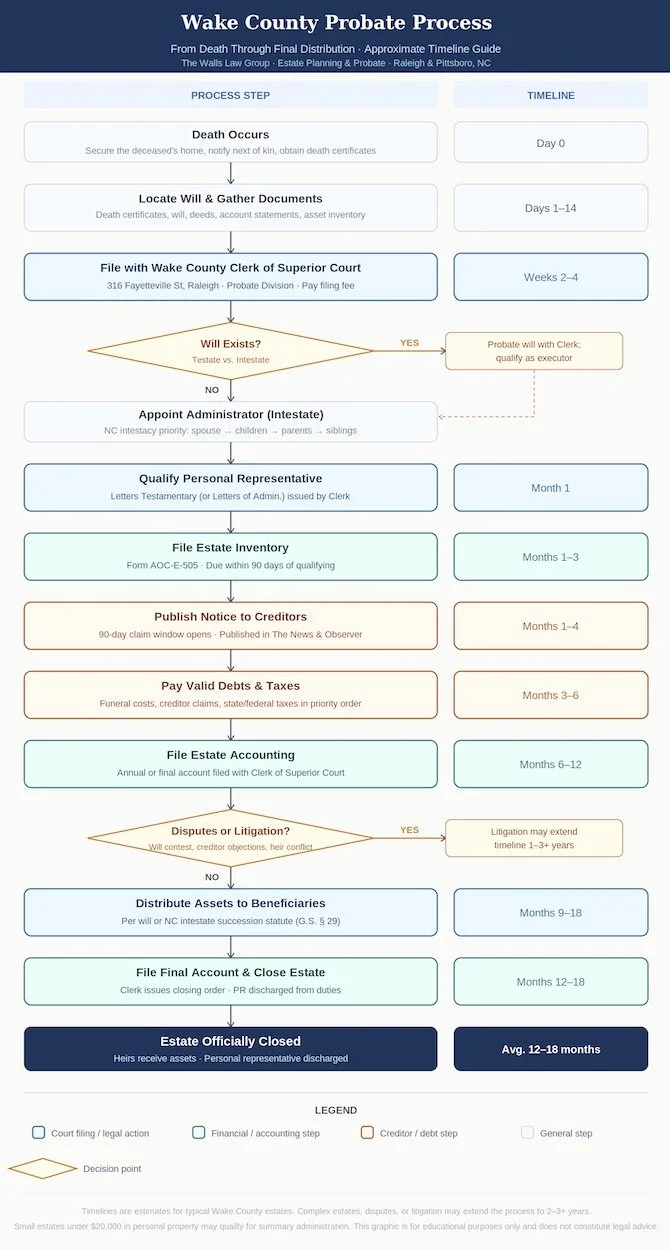
Flowchart showing the Wake County probate process from death through final distribution.
What is probate and how does it work in Wake County?
Probate is the court-supervised legal process for settling a deceased person’s estate. In North Carolina, probate is governed by NCGS Chapter 28A and administered through the Clerk of Superior Court rather than a traditional courtroom judge. The Clerk has original jurisdiction over estate proceedings, including appointing the personal representative, overseeing creditor claims, and approving the final accounting.
• If the deceased left a valid will, the Clerk appoints the executor named in the will as the personal representative. If there is no will, the Clerk appoints an administrator under NCGS §28A-4-1.
• All probate filings in Wake County are handled at the Wake County Clerk of Superior Court, located at the Wake County Justice Center in downtown Raleigh.
• North Carolina is a "common form" probate state, meaning most estates can be probated without a formal court hearing, unless someone contests the will.
According to NCGS Chapter 28A (Administration of Decedents’ Estates), which governs all probate proceedings in North Carolina.
The process is more straightforward than most people expect, but there are specific steps that must happen in order.
Here’s what I want you to understand about probate in Wake County: it’s not the nightmare you’ve read about online. Most of those horror stories come from states like California or New York, where probate can take two to three years and cost 5% to 10% of the estate value. North Carolina’s system is administered by the Clerk of Superior Court, which means it’s a more streamlined, less adversarial process.
That said, streamlined does not mean simple. There are deadlines, filing requirements, and creditor notice rules that must be followed precisely. Missing a deadline can expose the personal representative to personal liability. And quite candidly, that’s where most families get into trouble. They assume it’s just paperwork and miss a critical step.
For a definition of probate and what assets go through the process, see our probate in North Carolina glossary page.
What are the steps in the Wake County probate process?
The Wake County probate process follows a structured sequence under NCGS Chapter 28A. While every estate has unique circumstances, the core steps are consistent for most estates that go through formal probate.
1. File the will with the Wake County Clerk of Superior Court. The original will must be filed within a reasonable time after death. North Carolina does not impose a specific statutory deadline for filing, but delays can create complications. The person named as executor in the will files an application to be appointed as personal representative.
2. Qualify as personal representative. The Clerk reviews the application and, if approved, issues Letters Testamentary (for executors named in a will) or Letters of Administration (for administrators when there is no will) under NCGS §28A-6-1. The personal representative may be required to post a bond unless the will waives the bond requirement.
3. Publish notice to creditors. The personal representative must publish a notice to creditors in a newspaper of general circulation in Wake County. Under NCGS §28A-14-1, creditors have at least three months from the first publication date to file claims against the estate.
4. Inventory and appraise estate assets. The personal representative must file an inventory of all estate assets with the Clerk within 90 days of qualification. For high-value estates, formal appraisals of real property, business interests, and other non-liquid assets are typically required.
5. Pay valid debts and expenses. After the three-month creditor claim period closes, the personal representative pays valid claims in the priority order established by NCGS §28A-19-6: funeral expenses, costs of administration, taxes, medical expenses of the final illness, and then general creditor claims.
6. Distribute remaining assets and file final accounting. Once all debts, taxes, and expenses are paid, the personal representative distributes remaining assets according to the will (or according to NCGS Chapter 29 intestacy rules if there is no will) and files a final accounting with the Clerk.
According to NCGS Chapter 28A, including §28A-6-1 (qualification), §28A-14-1 (creditor notice), and §28A-19-6 (priority of claims).
Each of those steps has its own timeline, and they overlap in ways that can catch families off guard.
Let me be very clear with you about something: the personal representative role is a real job. It’s not an honorary title. The person handling this is personally responsible for following every one of those steps correctly, and if they distribute assets before the creditor period closes or miss a required filing, they can be held personally liable for the shortfall.
I see this most often with high-income families where the estate includes multiple asset types. There’s a home in North Hills, a brokerage account, a retirement account, maybe an ownership interest in a medical practice or law firm. Each asset type has different handling requirements during probate. The retirement account has a beneficiary designation and may not go through probate at all. The home might be jointly owned, which also bypasses probate. The brokerage account might be titled solely in the deceased’s name and must go through the full process.
The point is this: knowing which assets go through probate and which don’t is just as important as understanding the steps themselves.
How long does probate take in Wake County?
Standard probate in Wake County takes approximately 6 to 12 months for straightforward estates with no contested claims. The three-month creditor claim period under NCGS §28A-14-1 establishes the minimum practical timeline before the personal representative can begin final distributions.
• Estates with no real property disputes, no contested claims, and clear beneficiary instructions typically close within 6 to 9 months.
• Estates involving business valuations, real property in multiple counties, or disputed creditor claims commonly extend to 12 to 18 months.
• Contested wills (will challenges filed under NCGS §28A-2A-4) can extend probate to 2 years or more if the case moves to a formal trial before a Superior Court judge.
• Small estates where the decedent’s personal property (net of liens) does not exceed $20,000 ($30,000 for a qualifying surviving spouse) can bypass formal probate entirely through the affidavit collection process under NCGS §28A-25-1, which can be completed in as little as 30 days after the waiting period.
According to NCGS Chapter 28A, §28A-14-1 (creditor notice period) and §28A-25-1 (small estate affidavit).
The timeline is one thing. The cost is another conversation entirely.
Here’s what I tell clients who are worried about the timeline: the three-month creditor window is the anchor. Nothing significant happens before it closes, because the personal representative needs to know the full picture of debts and claims before distributing anything. So even in the simplest estate, you’re looking at a minimum of 4 to 5 months from filing to final distribution.
For high-income families in Raleigh, the estates tend to be more complex. There are multiple accounts, possibly a business interest, real property, and retirement assets with their own distribution rules. Each of those adds time. Not because the court is slow, but because the personal representative has to handle each piece correctly.
And quite candidly, the families who have the smoothest probate experiences are the ones who had a plan in place before they needed one. When the will is clear, the beneficiary designations are current, and the personal representative knows what to expect, the process moves efficiently.
What does probate cost in Wake County?
Probate costs in Wake County include court filing fees, publication costs for the creditor notice, potential bond premiums, appraisal fees, and attorney fees. The total cost varies significantly based on the complexity and value of the estate.
• Court filing fees for opening an estate with the Wake County Clerk of Superior Court are typically in the $100 to $200 range, though fees are updated periodically.
• Publication costs for the required creditor notice in a Wake County newspaper typically run $75 to $150 depending on the publication.
• Attorney fees for probate administration in North Carolina are not set by statute and are typically billed on an hourly basis or as a flat fee. Fees for straightforward estates commonly range from $2,500 to $5,000, while complex estates can run significantly higher.
• Personal representative compensation is governed by NCGS §28A-23-3, which allows reasonable compensation. If the will does not specify compensation, the Clerk determines reasonableness based on the size and complexity of the estate.
According to NCGS §28A-23-3 (personal representative compensation). Filing fees subject to current Wake County Clerk of Superior Court fee schedule.
These costs add up, and they’re one of the primary reasons high-net-worth families look for ways to keep assets out of probate entirely.
I want to be upfront with you about costs because this is where people get surprised. The court filing fees themselves are modest. But when you factor in attorney fees, appraisal costs for a $700,000 to $1,200,000 home, potential business valuations, and the time the personal representative spends managing the process, a high-income estate in Raleigh can easily see total probate costs in the $5,000 to $15,000 range.
And that’s for an uncontested estate. If someone challenges the will, or if there’s a dispute about how assets should be distributed, you’re looking at litigation costs that can reach $25,000 to $50,000 or more.
Compare that to the cost of setting up a comprehensive estate plan with a revocable living trust that avoids probate entirely. For most high-income families, the estate plan pays for itself the first time it’s used.
Can high income earners in Raleigh avoid probate?
Yes. North Carolina law provides several mechanisms that allow assets to transfer outside of probate. For high-income earners in Raleigh, the most effective strategies include revocable living trusts, beneficiary designations on financial accounts, and forms of joint ownership that include a right of survivorship.
• Revocable living trust. Assets titled in a properly funded revocable living trust transfer to beneficiaries according to the trust terms without probate court involvement. The trust remains revocable and amendable during the grantor’s lifetime under NCGS §36C-6-602. This is the most comprehensive probate avoidance tool for high-value estates.
• Beneficiary designations. Retirement accounts (401(k), IRA), life insurance policies, and transfer-on-death (TOD) or payable-on-death (POD) accounts pass directly to named beneficiaries and do not go through probate. These designations override what the will says.
• Joint ownership with right of survivorship. Real property and bank accounts held as joint tenants with right of survivorship or as tenants by the entirety (for married couples) pass automatically to the surviving owner at death without probate.
• Small estate affidavit. When the decedent’s personal property (net of liens) does not exceed $20,000 ($30,000 for a qualifying surviving spouse), NCGS §28A-25-1 allows collection by affidavit without opening a formal estate. This option is rarely applicable to high-income earners but is worth noting for completeness.
A revocable living trust only avoids probate for assets that have been retitled into the trust. Assets left in the grantor’s individual name at death still go through probate, regardless of what the trust document says. This is the single most common estate planning mistake: creating a trust but failing to fund it.
According to NCGS Chapter 36C (North Carolina Uniform Trust Code), Article 6, governing revocable trusts.
The tool you choose depends on the assets you’re protecting and how much control you want to maintain.
Let me be very clear with you about this: a will does not avoid probate. I know that seems counterintuitive, because most people think having a will means your family is protected. A will is important. It tells the court who gets what. But it has to go through the probate process to be enforced. A revocable living trust, on the other hand, operates outside the court system entirely.
For high-income professionals in Raleigh, the revocable living trust is typically the foundation of the estate plan. You transfer your home, your brokerage accounts, and other assets into the trust during your lifetime. You remain in full control. You can change anything at any time. But when you pass away, those assets transfer to your beneficiaries according to the trust terms without a single court filing.
I want to strongly encourage you to think about this in terms of what your family will experience. Without a trust, your surviving spouse or children are walking into the Wake County Clerk’s office, filing paperwork, waiting three months for creditors, and spending 6 to 12 months managing the process. With a trust, they’re meeting with the successor trustee and receiving their inheritance on a timeline measured in weeks, not months.
For a detailed comparison of revocable and irrevocable trusts, see our revocable vs irrevocable trust glossary page. For guidance on how trusts fit into a broader estate plan for high earners, see trusts for high income earners in North Carolina.
Frequently asked questions
What happens if someone dies without a will in Wake County?
If someone dies without a valid will in North Carolina, their estate is distributed according to the intestacy rules in NCGS Chapter 29. The Clerk of Superior Court appoints an administrator (rather than an executor) to manage the estate. The distribution follows a statutory hierarchy: surviving spouse, then children, then parents, then siblings. For a full breakdown of how assets are divided, see our page on intestacy and blended families in North Carolina.
Can I serve as my own personal representative in Wake County?
Yes. North Carolina allows individuals named in the will to serve as personal representative (executor) without hiring an attorney, though hiring one is strongly recommended. The personal representative has legal obligations under NCGS Chapter 28A, including filing deadlines, creditor notice requirements, and accounting duties. Mistakes can result in personal liability, so most families benefit from professional guidance.
Do all assets go through probate in North Carolina?
No. Only assets titled solely in the deceased person’s name go through probate. Assets held in a trust, accounts with beneficiary designations (retirement accounts, life insurance, TOD/POD accounts), and jointly owned property with right of survivorship all bypass probate. For high-income earners, this means the majority of the estate can often be structured to transfer outside of probate with proper planning.
Is probate public record in Wake County?
Yes. Probate filings in Wake County are public record. This includes the will, the inventory of assets, creditor claims, and the final accounting. For high-net-worth families who value financial privacy, this is another significant reason to consider a revocable living trust. Trust administration is private and does not create public court records.
Probate in Wake County is not as burdensome as in many other states, but it’s still a process that takes time, costs money, and puts your family’s financial details into the public record. For high-income professionals in Raleigh, the better question isn’t how to navigate probate. It’s how to avoid it for the assets that matter most.
If we can be of assistance to you in creating an estate plan that minimizes or eliminates your family’s exposure to probate, please schedule a free discovery call or reach out to us at 919-647-9599.

About the Author
Jason Walls, J.D., is the Founder and Chief Legal Officer of The Walls Law Group, a North Carolina law firm focused on helping business owners and families protect, preserve, and transfer wealth through estate, business, and asset protection planning.
This content was reviewed on March 17th, 2026
Disclaimer: This page is for educational purposes only and does not constitute legal or tax advice. The information provided is general in nature and may not apply to your specific situation. Estate planning, probate administration, and trust administration involve complex legal and financial considerations that vary based on individual circumstances. For specific legal advice tailored to your circumstances, please schedule a consultation with a qualified estate planning attorney. Laws are subject to change, and the information on this page reflects the law as of February 2026.